quantum engine

A curious article hit my feed this week for a topic I had never heard of in physics, a quantum engine. I wanted to take a short article as a primer on quantum physics to understand how a quantum engine works, and then briefly discuss the findings of the full paper.
Quantum Primer
Now let’s go all of the quantum pieces. Note everything I talk about here will be confusing, because quantum is very confusing. We lack good analogies, and don’t have the full picture yet. It’s just people trying to figure things out after all!
The first topic we will tackle is spin. Spin is an intrinsic attribute to particles like mass is. It’s just something they have. More specifically, it’s a term used to describe a set of behaviors we can’t explain via anything else. Specifically, it has to do with the results of the Stern–Gerlach experiment as seen here:
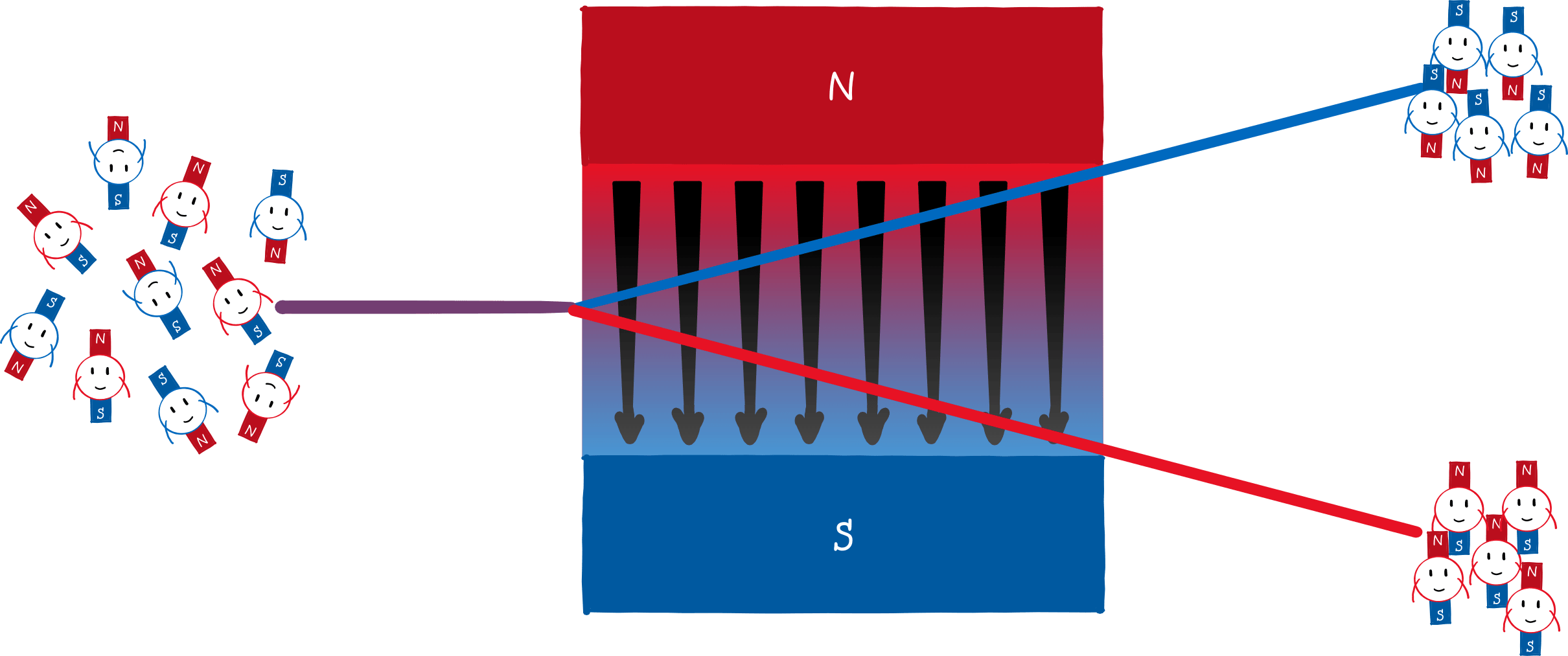
What we have is a set of particles moving through a magnet. We would expect one of two things to happen. If a particle is slightly magnetic, we would expect all of the particle to evenly spread out depending on which way the poles of the particle’s magnet are facing. The more the particles magnet lines up opposite of the big magnet, the more it is drawn in that direction. Alternatively, if the particle isn’t magnetic, we would expect the particle to pass through without being drawn in any particular direction. However, neither of these things occur. Instead, the particles spread out evenly into two distinct groups. It’s as if half the particles have an internal magnet facing exactly up, or exactly down. Even weirder, if you run this through again but with the big magnet in a different orientation, the particels completely forget their previous orientation, and once again evenly split between left and right. Even non charged particles, like neutrons, have this attribute, so it’s not indicative of charge or velocity. Since we have no either explanation, we call the attribute that causes the phenomenan spin, with particles in the up group being spin up, and those in the down group spin down.
Why call it spin? Two big reasons. Firstly, spin shares many algebraic properities with orbital angular momentum. Angular momentum is energy created from spinning. Second, in classical mechanics, a charged spinning object creates a magnetic field via an electrical current. It was thought that electrons were doing the same thing, just at a microscopic level. This turned out to be false, but the name stuck. We know this to be false because if it were spinning, given the electric field, we would be able to measure it’s size, and those size measurements would make the particle vastly too large compared to what we know. So when you think spin, think intrinsic magnetic property of particles.
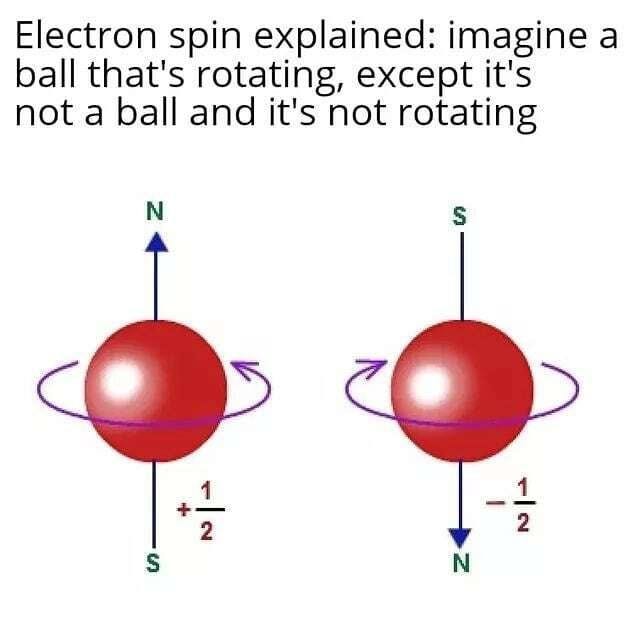
Sadly, it’s a little more complicated! Spin can be quantized, meaning it can take on numeric values. While I said we think of particle as either spin up or spin down, some particles can exhibit more spin directions. We refer to the number of different spin positions a particle can be in as Spin-n, where the number of potential spin states the particle is in is evenly distributed ℏ distance apart between n * ℏ and -n * ℏ. ℏ here being planck’s constant. Let’s show an example. An electron is Spin-1/2. This means it can be in state 1/2 ℏ (up), or - 1/2 ℏ (down). We get there by subtracting 1 * ℏ, until we hit the negative. If we had spin 3/2 ℏ, then we would have states 3/2 ℏ, 1/2 ℏ, -1/2 ℏ, -3/2 ℏ. All the values between n * ℏ and -n * ℏ, evenly spaced via ℏ. Here these different spin states refer empircally to the number of groups that get created while passing through the big magnet, with each group having that amount of angular momentum (i.e. how fast it’s “spinning” given its mass).
Now let’s talk about Bosons and Fermions. All particles are either Fermions or Bosons. Fermions, in general, are particles of mass (electrons, neutrons, etc) while Bosons are force carrying particles (photons, gluons, etc). The main characterizing difference is wether they abide by the Pauli Exclusion Priciple. The Pauli Exclusion principle states that no two fermions may exist in the same quantum state. Another way to phrase this is that for bosons the wave function is symmetrical, meaning we cannot differentiate them while for fermions it is not symmetrical meaning we can differentiate between them.
What is a quantum state? It’s still widely up for debate, but the general picture is that the quantum state is a set of values that capture the current status of a particle. For example, take two electrons in the same orbital shell, i.e. same ring orbiting the nucleus. These electrons will have all of the same characteristics, but because electrons are fermions we know they will have to at least have different spin directions, i.e. one will be up and one will be down. Bosons on the other hand, can be completely indistinguishable, and can thus all enter the same exact quantum state, like photons in a laser. Once again, we are attempting to describe observed behavior, and we use the Pauli Exclusion Principle to explain the behavior of these large classifications of particles. The resulting behavior/distribution of particles as a result of this property is reffered to as Bose-Einstein statistics for Bosons, and Fermi-Diract Statistics for Fermions.
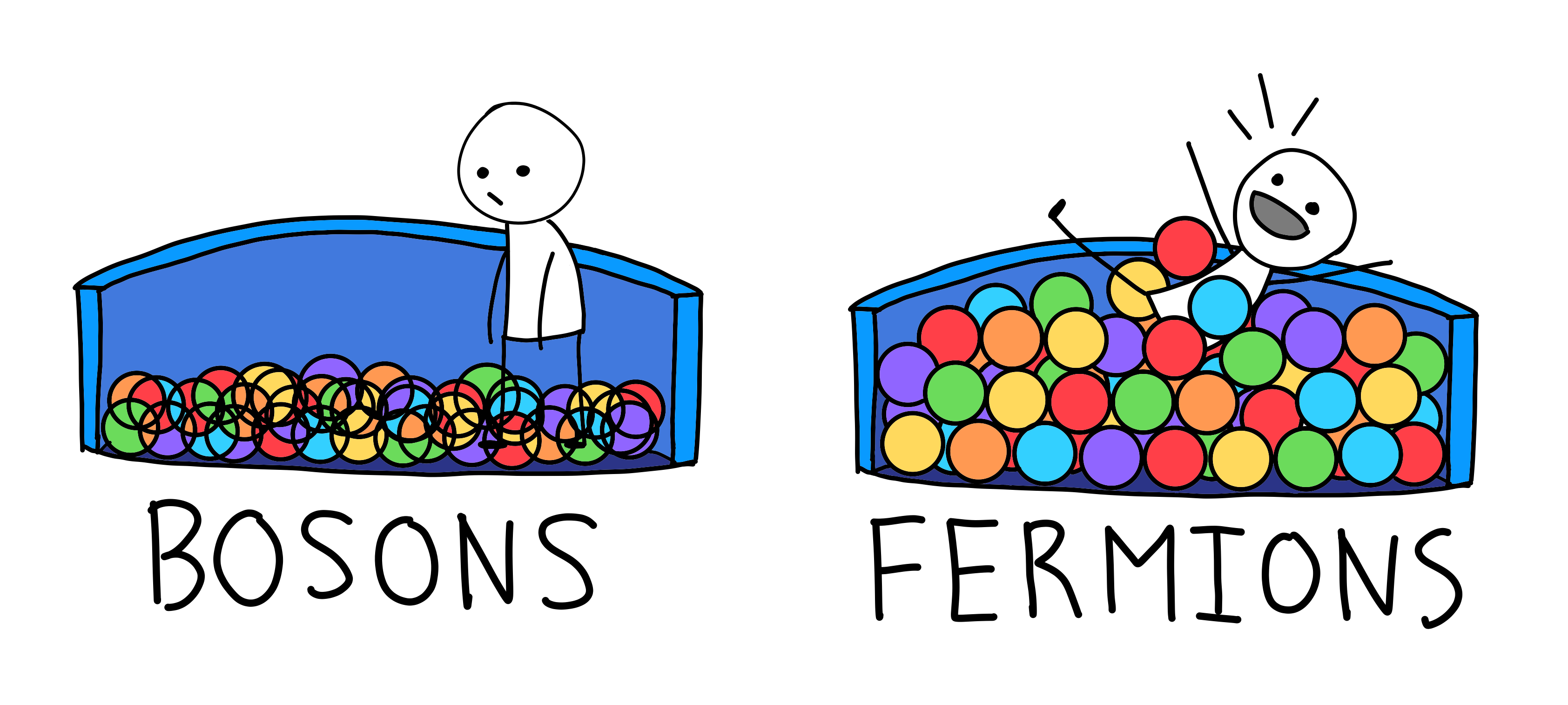
Lets connect spins to Bosons and Fermions. Fermions always have half integer spins (1/2, 3/2, etc), while bosons have full integer spins (1, 2, etc). What does this mean? When we think about spin, we think about angular momentum. Angular momentum is how fast the particle is spinning given it’s mass. We say that a particle makes a full rotation every ℏ/2π (h-bar), and that the angular momentum, i.e. how fast it is “spinning”, is indicative of a scalar times h-bar. Through empirical study, the value of that scalar is half integer for fermions and whole integers for bosons. People discuss this a lot in the literature, but it doesn’t seem to have any major implications
A question you probably didn’t have is what happens when we make these two distinct groups very very cold. Like absolute zero cold for Bosons this substance becomes Bose-Einstein condensate, a superfluid. This is essentially a bunch of distinct bosons that all begin to move as one large mass.
An interesting discovery was the ability to use magnetism to create a source of resonance that occurs in the bose-einstein condensate, allowing us to change the super fluid state from being determined by Bose–Einstein to Fermi–Dirac statistics. What is resonating, and how does it enable manipulation? The theory is that there is a Two Channel model for interaction of particles: one channel is working for particles to bounce off each other, and the other wants to bind particles together when they collide. These two channels have different “magnetic moments”, which we can take advantage of as seen here:
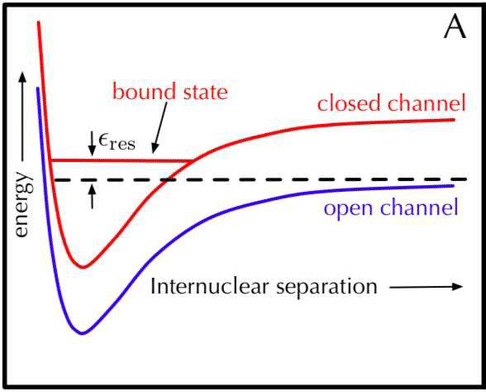
Here we are attempting to align (create resonance) the magnetic potential of the closed channel (εᵣₑₛ) with the scattering length of the open channel (the blacked dash line). A helpful but incorrect analogy might be two magnets. We can either have them attracting (closed channel), or repelling each other (open channel). What we seek to do is put them in a state where they can attract and repel freely depending on the alignment on an external magnetic field. We are attempting to do the same thing here, but utilizing the spin of particles. This is only possible while cold because the cold removes all energy from the system, which greatly lowers the amount of kinetic energy dictating the open system, allowing us to create this resonance between the two. The magnetic field to control this is called the Feshbach resonance.
What’s odd two is that we can use this tool to turn a fermion into a boson. This sounds crazy. However, consider our earlier definition, that the difference between bosons and fermions was whether the wave function was symmetrical. However, using Fermach resonance, we are able for particles to begin behaving as one. We are tuning the amount of energy in the system so that the particles aren’t bouncing off each other, they are sticking together. By behaving as one, the wave function now behaves as one, which makes it symmetrical and thus the condensate now begins behaving like a boson. By binding two fermions, we have inadvertately created a system that behaves like a boson.
Quantum Engine
How can we take advantage of this fact to make an engine? Well consider the ball pit photo from above. We have a bunch of fermions behaving like bosons, which means that via magnetic force we are packing them all together really close. Then, by releasing the resonance, the fermions are suddenly fermions again, and must expand back out into different quantum states to abide by the Pauli Exclusion Principle. This means there was a change in energy, as the particles expand out to different energy levels in order to situate different quantum states! An energy we can measure, and potentially take advantage of. We can take advantage of it in the same way we do a normal car engine. Utilize the sudden change from condensed solid into highly concentrated gas to turn the reaction’s energy into mechanical energy. Sadly, we don’t actually put it to work in a mechanical engine. The Pauli Engine is a hypothetical engine whose work we can measure given the change in energy that occurs during the change in state. Here we see a diagram from the experiment.
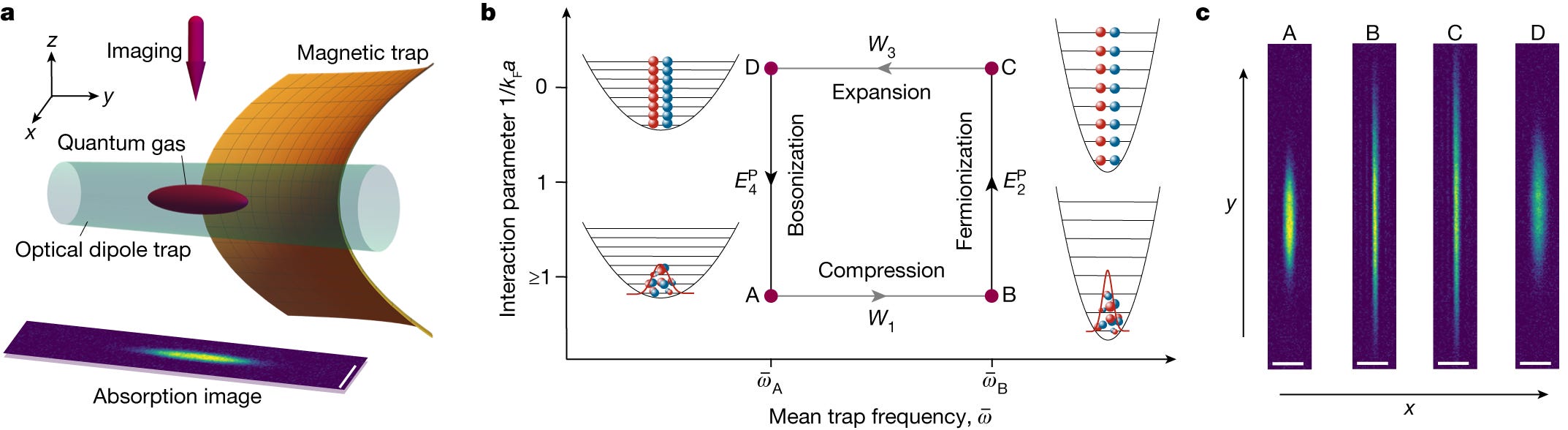
On the left we see the expermental setup, with a quantum gas trapped in a vacuum, with a magnet situated to activate the Feshbach resonance. In the center are the 4 phases of the engine. Bosons are compressed into the lowest energy state, we turn them into fermions, those fermions expand out into multiple energy states, and then the fermions are turned back into bosons.
The researchers got an energy efficiency of about 25%, with a hypothetical efficiency of about 50%. This puts it in line with average gas engines, which are usually in the 20% to 30% range.
Conclusion
I love finding the exploits inside physics. The most interesting engineering solutions always come from them. Whether it’s using a lever or pully to gain mechanical advantage, or abusing the way unnstable radioactive elements behave under stress to create nuclear energy, physics helps inform where we should build next. I wonder how machine learning will help optimize this process? Perhaps it will be able to perform experimental design, or help discuss ways to engineer things that take advantage of the principles we discover. Or perhaps it will even be able to simulate these behaviors, and thus discover new science from first principles? It’s a very exciting time for physics and machine learning!